
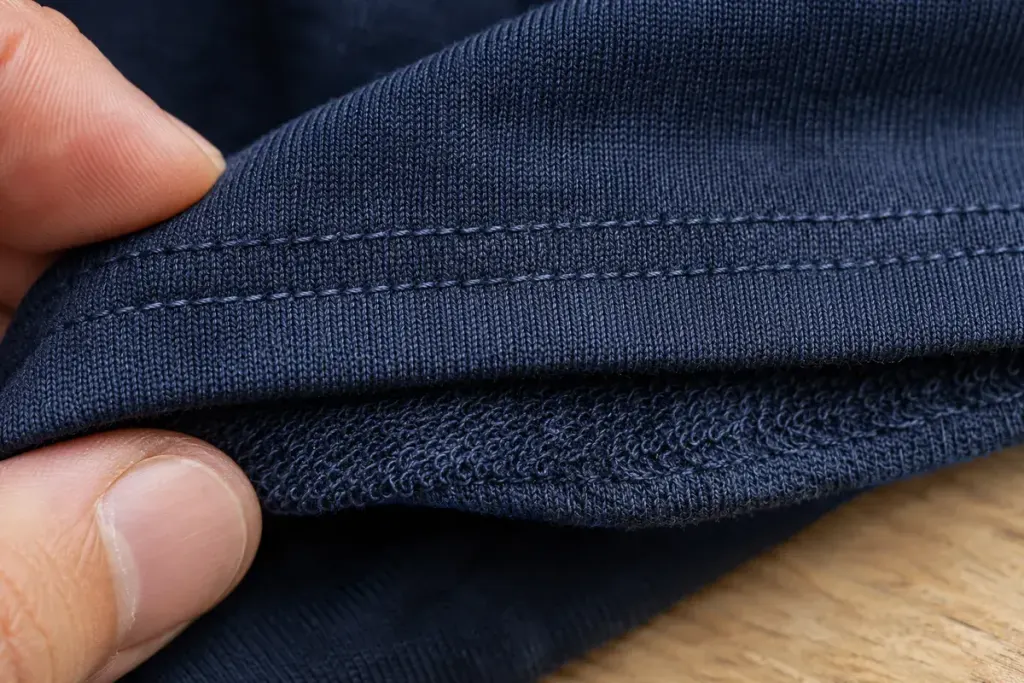
Two neat lines of stitching run around the sleeve of a knit uniform top. Turn it inside out and the threads look quite different: loops connect the rows across the folded hem. This is a common place to find a coverstitch.
BERNINA’s guide to serger stitches describes coverstitching as a useful construction for knit hems. Unlike an overlock stitch that wraps an exposed fabric edge, a coverstitch can sew across a folded section. Its looper threads help the stitching accommodate stretch.
Read both sides of the hem
The face may show two or three parallel needle rows, depending on the setup. Underneath, the interconnecting threads cover a wider area. A twin needle on a conventional sewing machine can create a similar-looking pair of rows on the face, but that appearance alone does not identify the stitch underneath.
If you are comparing two work tops, look at an actual hem rather than relying on a product photograph. Note where the fold sits, whether the stitching lies flat and whether any thread is already loose. The stitch name is useful information, but it is not a complete quality assessment.
- Check the garment’s fibre and care label before evaluating how it should behave.
- Move the hem gently within the fabric’s normal stretch; do not pull until something breaks.
- Notice whether the stitching restricts ordinary movement or the folded edge rolls uncomfortably.
- Follow the specified wash routine and reassess fit after laundering when permitted.
For an alteration, show the whole garment to someone familiar with stretch fabrics. Shortening a top changes the location of the hem as well as its construction, so mark the length while wearing it in a normal working posture.
A tidy coverstitched edge does not establish fluid resistance, infection-control suitability or any protective certification. Those are separate requirements. Keep workplace rules and the garment’s intended use in view before replacing or modifying a uniform.