
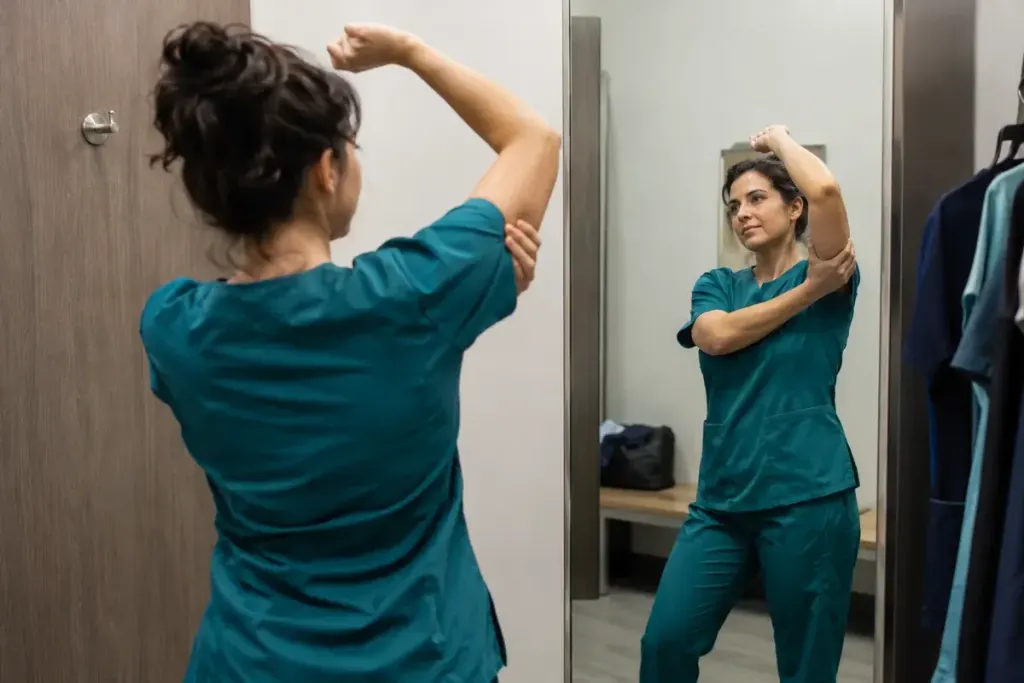
A scrub top can look neat while you stand still and pull awkwardly when you reach. Trousers can feel comfortable until you sit, bend or load a pocket. Try the movements your work actually involves before deciding that a size fits.
Begin with the employer’s uniform requirements, including colour, coverage and any restrictions on pockets or accessories. Ordinary scrubs are work clothing; they do not replace the protective equipment required for a particular task.
Use a small movement circuit
In a suitable changing area, sit, stand, reach forward and raise your arms comfortably. Check whether the fabric restricts you, the neckline shifts unexpectedly or the hem no longer provides the coverage you need. Bend as you ordinarily would, without forcing an exaggerated pose to make the garment fail.
Try trousers with the shoes you expect to wear. Look at the hem when walking and sitting, and check that the waistband stays secure without digging in. A drawstring should help adjust the fit, not compensate for a fundamentally unsuitable cut.
Test pockets realistically
Use clean, safe stand-ins for the small items you normally carry, if the retailer permits it. Notice whether the garment twists or sags. A pocket count on a label says little about whether the pockets are useful in your role. Follow workplace rules about what may be carried and how equipment is handled.
Check seams and stretch in areas that move. Stretch fabric does not mean every size will fit, and two garments with the same labelled size can have different proportions. Consult the brand’s measurements rather than assuming a familiar size transfers automatically.
Consider the garment after laundering
Read the care instructions before buying. The US Federal Trade Commission’s care-labelling rule explains the role of care information for clothing sold in its jurisdiction. The practical point for a buyer is to check whether the permitted care fits the workplace’s requirements; do not assume all uniforms tolerate the same process.
Keep your comparison simple: movement, coverage, pockets, length and care compatibility. If possible, test one set before purchasing several. Ask about returns before wearing or washing it. A useful work uniform lets you carry out ordinary tasks without repeatedly adjusting it, and remains suitable under the care procedure you are expected to follow.