
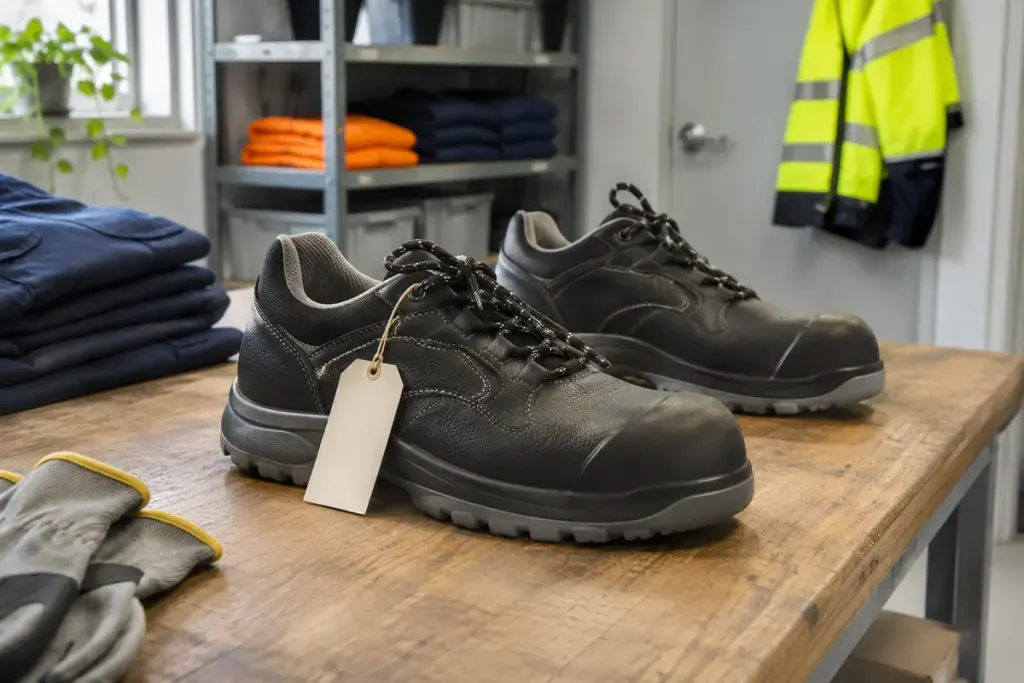
A shoe has a protective toe cap, so it must protect the whole foot from workplace hazards. That assumption can leave an important gap. Resistance to an impact at the toes and resistance to a sharp object entering through the sole are different protective properties.
The UK’s Health and Safety Executive’s PPE guidance explains why equipment should match the hazards and working conditions. Footwear selection can involve impact, penetration, slips, chemicals, heat and other risks. No single visible feature answers all of those questions.
Read the complete specification
Ask for the product information identifying the relevant certification, protective properties and limitations. Use current guidance for your jurisdiction and workplace rather than decoding a marking from an old chart without checking its version.
A toe-cap material label, such as steel or composite, does not by itself tell you whether the shoe includes a penetration-resistant component. Nor does a deep-looking tread prove that the sole is suitable for every slippery surface.
HSE’s construction PPE questions provide a practical example of considering toe and sole hazards separately. That setting should not be copied indiscriminately into clinical work: a hospital role, workshop and construction site can require different footwear properties.
Bring the task to the fitting
Discuss the actual work with the person responsible for the risk assessment. Include surfaces, cleaning requirements, time spent standing, exposure to fluids and any other relevant conditions. Protective features need to work alongside fit and the rest of the uniform.
- Confirm which hazards the footwear is intended to address.
- Check the exact model’s documentation, not a similar-looking product.
- Try the appropriate size with the socks and any approved inserts you will use.
- Follow inspection, cleaning and replacement instructions.
Do not modify protective footwear or add an insert without checking compatibility when it could affect fit or certification. Report damage and changes in condition through the workplace’s process.
A useful purchase record contains the model, size, specification and reason it was selected. It helps a replacement order preserve the required protection instead of buying whichever shoe most closely resembles the old pair. The question is not whether footwear looks sturdy, but whether its documented properties match the work.