
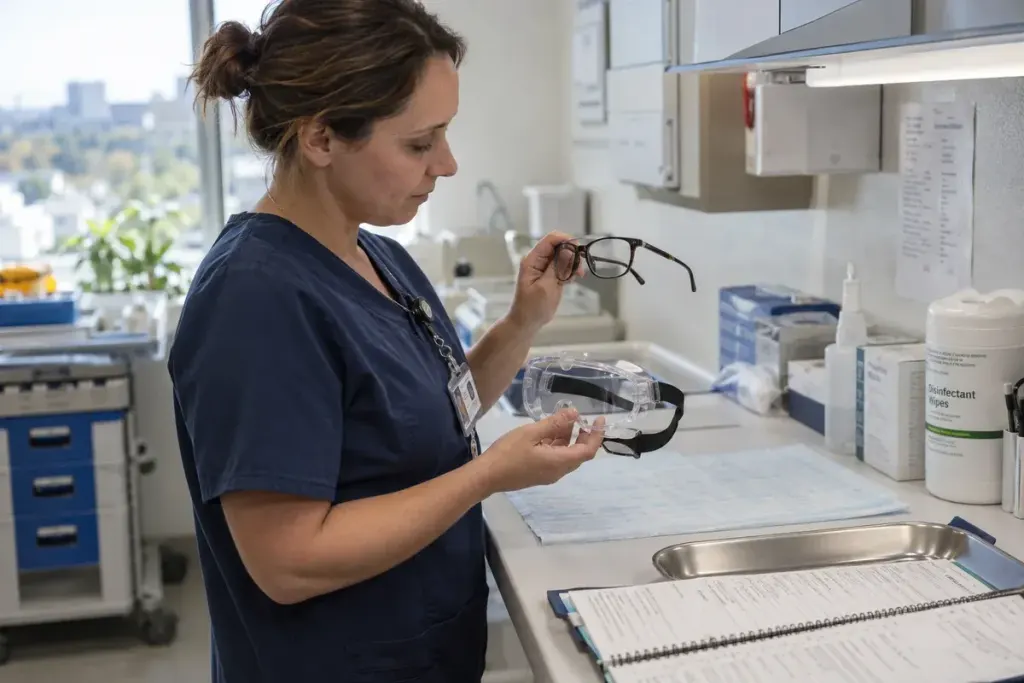
Prescription glasses help you see, but they are not automatically suitable protection from an occupational splash. The open areas around ordinary frames and their intended purpose matter. Choosing healthcare eye protection begins with the workplace’s risk assessment and infection-control requirements.
Do not choose protective equipment solely because it resembles a pair already worn comfortably. The task, exposure route and required protection determine the appropriate type, together with relevant standards and local procedures.
Check the complete combination
The CDC’s eye-protection guidance discusses goggles, face shields and other options, including fit with other equipment. Personal eyeglasses and contact lenses should not be treated as substitutes for the required protective eyewear.
If you wear prescription glasses, ask which approved options fit over them or provide an appropriate prescription solution. Try the selected equipment together with the other PPE used for the task. A comfortable fit in isolation may change when combined with a mask, respirator or head covering.
Visibility is part of safe use
Check that the equipment stays in place and allows the necessary field of view. Report fogging, distortion or pressure that interferes with work. Do not modify, drill or remove parts of protective equipment to make it more comfortable unless the manufacturer and workplace procedure explicitly allow it.
Ask for instruction on putting the equipment on, removing it and cleaning or discarding it. Reusable products need the approved method and compatible cleaning agents. A wipe suitable for one surface may damage another material or leave the protection ineffective.
- Use the type specified for the assessed task.
- Check compatibility with prescription glasses and other PPE.
- Inspect for damage before use.
- Follow the approved cleaning and storage procedure.
- Report fit or visibility problems promptly.
Keep clean equipment protected from contamination and scratches between uses. Follow the employer’s replacement criteria rather than waiting for damage to become dramatic. If an exposure occurs, use the workplace’s immediate response and reporting process.
Product appearance and comfort are useful considerations only after the required protection has been established. The right question is not whether the eyewear looks substantial, but whether it is appropriate for the task, fits the wearer and can be used correctly as part of the complete protective system.