
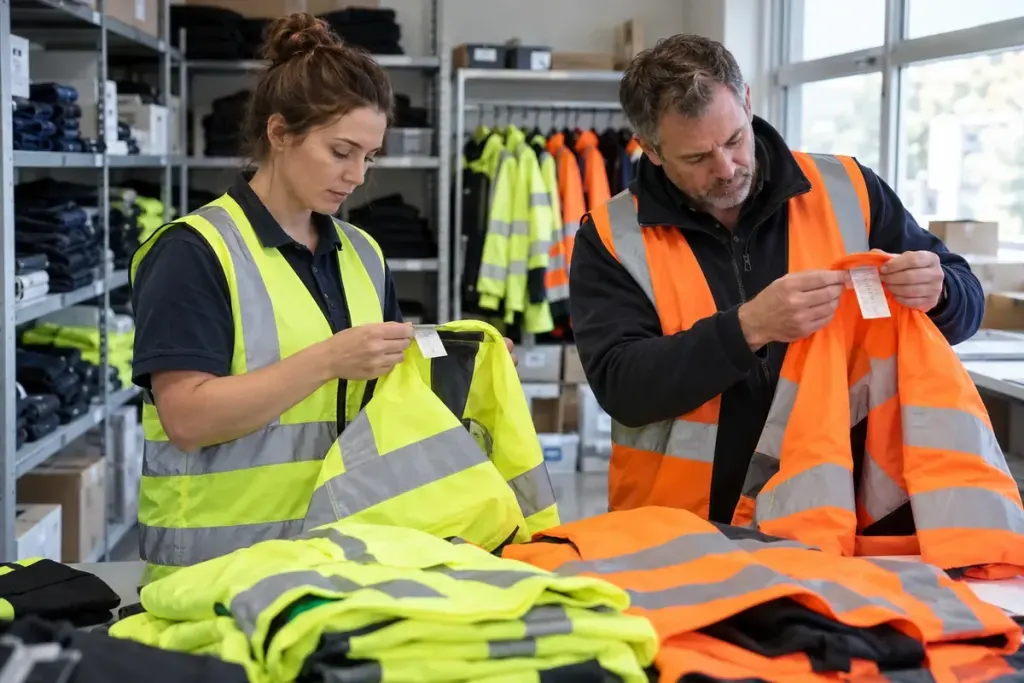
A bright yellow jacket may look suitable for a work site. Colour alone does not establish whether it meets the protection requirement for that job. High-visibility clothing should be selected as part of the workplace’s risk assessment and equipment process.
The UK Health and Safety Executive’s PPE overview places protective equipment within the wider control of workplace risks. Requirements differ by task and jurisdiction, so ask the employer or responsible safety professional for the specification that applies to the actual work.
Check the label against the requirement
Confirm the garment’s stated standard, class or performance marking with the approved specification. Do not infer compliance from a product photograph or a seller’s use of the word “safety.” Keep the manufacturer’s information available for checking and care.
Try the garment over the layers you will wear. It should fit the work without creating loose material that catches or restricting necessary movement. Consider compatibility with other equipment, including harnesses, weather protection and any task-specific PPE.
- Wear the garment as designed, including fastenings.
- Do not cover important visible areas with an unrelated outer layer.
- Follow the specified washing method and any wash-cycle limits.
- Report damage, heavy soiling or fading that may affect performance.
Ask how replacement is arranged before the garment becomes unusable. A worker should not have to decide independently whether a damaged reflective strip still provides adequate protection.
High-visibility clothing does not replace traffic separation, suitable lighting, safe procedures or attention around moving equipment. It is one element of the system, and a driver seeing a garment cannot be assumed in every condition.
For purchasing records, keep the product model and specification alongside the issue date. That makes later replacement more reliable than ordering a jacket that merely looks similar to the old one.