
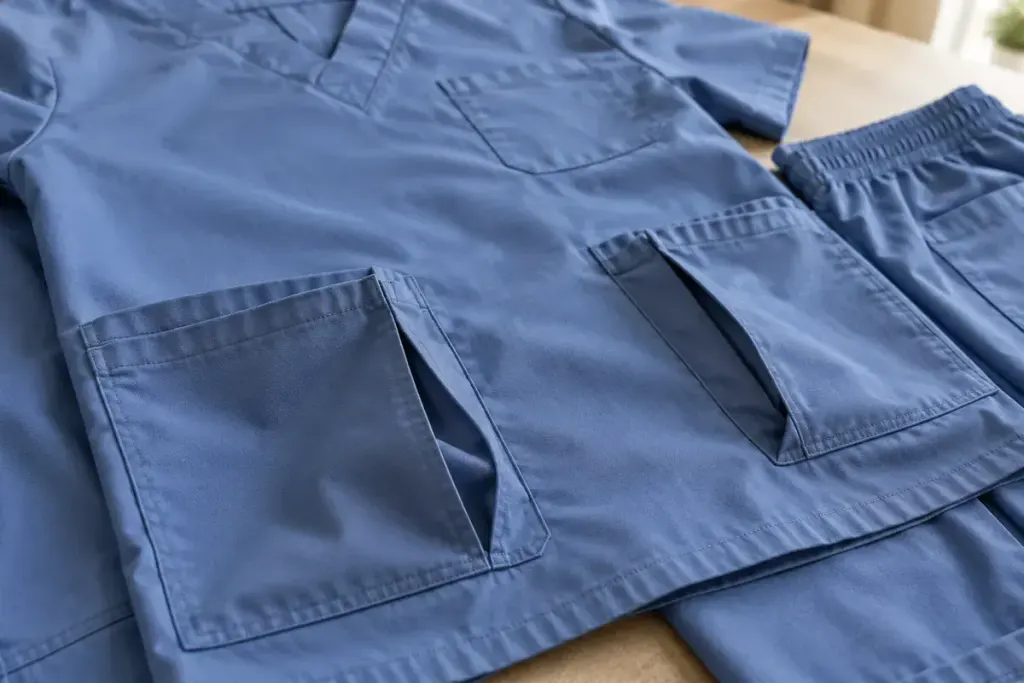
Two scrub tops can have pockets with almost identical openings while carrying small items differently. One pocket lies flat against the garment; another has folds that let its body expand. The second is often described as a bellows pocket.
Look at the construction rather than relying only on the product name. A fold at the side or bottom can provide extra volume, but brands use pocket terminology differently. Check photographs that show the pocket open as well as flat.
Judge the loaded shape
During a permitted fitting, use clean, harmless items similar in size to what your role allows you to carry. Notice whether the pocket hangs neatly, pulls the garment forward or places a bulky object where it presses when you sit.
An empty pocket can disappear into the fabric while a loaded one catches against a desk or extends into a working area. Reach, bend and sit comfortably to understand that change. Do not use sharp or clinical equipment for a casual clothing test.
Check the opening too. Additional volume does not guarantee that an item can be retrieved easily with one hand. A narrow opening over a deep pocket may keep contents secure but make a small object difficult to find.
Capacity is not a carrying instruction
Follow your employer’s rules about what may be carried and how items must be stored. A garment pocket is not automatically an approved place for medicines, sharps, confidential information or equipment that needs a dedicated holder.
Compare the pocket’s position with any belt, badge or outer layer you wear. The combination may matter more than the pocket considered by itself.
When laundering, empty every fold and follow the care label and workplace process. Inspect seams and openings for damage; an expanding construction still relies on sound stitching.
The best choice is the pocket that works with the items and movements your role actually permits. Extra fabric is useful when it solves a practical problem, rather than simply encouraging you to carry more.