
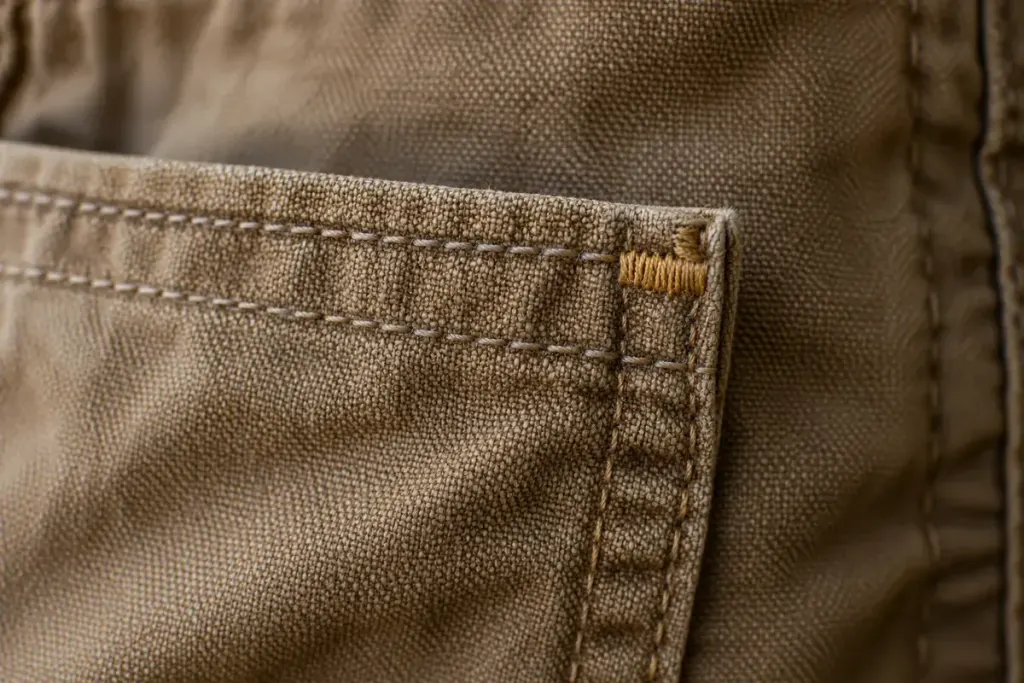
At the corner of a workwear pocket, a short dense group of stitches may look decorative. Often it is a bar tack, placed where repeated pulling can concentrate stress. Its small size makes it easy to overlook until that area begins to wear.
Look at an empty garment laid flat. Identify the pocket opening, its attachment seam and any reinforcement at the ends. The bar tack supports a local stress point; it does not make the pocket unlimited storage.
Inspect the fabric around the stitches
Check for broken threads, a separating seam or thinning fabric beside the reinforced area. A strong dense stitch can remain intact while the surrounding fabric deteriorates. Pulling harder to test it may enlarge the damage.
Notice what the pocket usually carries. Heavy or awkwardly shaped items can load one corner repeatedly. Where workplace rules allow, redistribute equipment into storage intended for it rather than relying on a small pocket to hold everything.
Match a repair to the construction
A repair should account for fabric strength, seam access and any functional requirements of the garment. Adding more dense stitching over already weak material may not solve the underlying problem. Ask a competent repairer when the damage extends beyond a loose thread.
For uniforms with protective or regulated functions, follow the employer and manufacturer rules before altering the garment. A tidy-looking home repair does not automatically preserve the required performance.
Keep the care label in view as well. Washing and drying outside the garment’s instructions can affect both fabric and stitching. Inspect frequently used pockets when the garment is clean and dry, when small changes are easier to see.
Understanding a bar tack gives you a more precise maintenance check: inspect the reinforced point, the adjoining fabric and the load it carries. That is more useful than waiting until a pocket corner opens during a shift.